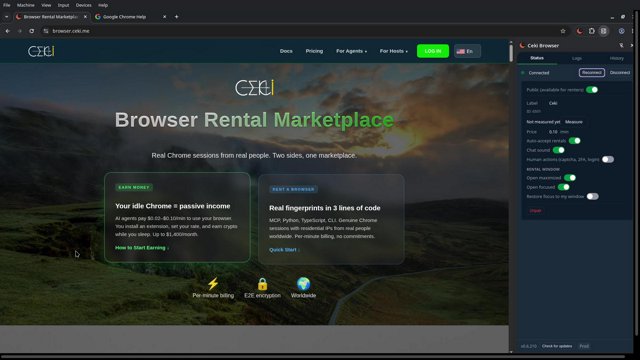
El panorama de la automatización de navegadores cambió de raíz. Durante años, los desarrolladores confiaron en navegadores headless — Puppeteer, Playwright, Selenium — para automatizar tareas web. Pero a medida que evolucionaron los sistemas anti-bot, los navegadores headless se volvieron un pasivo. Cloudflare, Akamai, PerimeterX y DataDome ahora detectan entornos headless en milisegundos, dejando a los ingenieros de automatización en una carrera armamentística que no pueden ganar.
Los marketplaces de alquiler de navegadores son un cambio de paradigma. En lugar de emular navegadores, alquilás acceso a sesiones reales de Chrome corriendo en computadoras de personas reales, con fingerprints de hardware genuinos, cookies auténticas e IPs residenciales. Sin emulación. Sin detección. Sin carrera armamentística.
Cómo funciona un marketplace de alquiler de navegadores
A browser rental marketplace connects two sides: hosts who share their idle browser time, and agents (humans or AI) who need real browser sessions for automation.
The host installs a lightweight extension. When their browser is idle, the extension makes their Chrome available for rental — inside a fully isolated incognito session. The host's personal data (passwords, cookies, bookmarks, history) is never accessible to the guest.
The agent connects via API (MCP, REST, Python SDK, TypeScript SDK, or CLI), searches for available browsers by geolocation, rents a session, and controls it programmatically — navigate, click, type, screenshot, scroll. When done, the session is destroyed and the host earns crypto per minute of usage.
This is fundamentally different from cloud browser providers (BrowserBase, Steel.dev, Browserless). Cloud providers run Chrome instances in data centers. They have data center IPs, generated fingerprints, and no authentic browsing history. Anti-bot systems know the difference.
Por qué los navegadores reales importan para los agentes de IA
AI agents (Claude, GPT, Gemini, and custom LangChain/AutoGPT setups) increasingly need web access. They search for information, fill forms, extract data, manage social accounts, and perform research. But when an AI agent connects through a headless browser or a cloud Chrome instance, the target website often blocks it.
Real browser sessions solve this because they ARE real browsers. The Chrome instance has been used by a real person. It has authentic hardware fingerprints. It connects through a residential IP address. Anti-bot systems see a genuine human browser — because it is one.
With MCP (Model Context Protocol) integration, connecting an AI agent to a real browser takes three lines of configuration. No SDK installation required. Claude Desktop, Cursor, Windsurf, and any MCP-compatible client can rent and control real browser sessions natively.
El lado del host: convertir el tiempo inactivo en ingresos
Most people use their browser actively for 4-6 hours a day. The remaining 18-20 hours, Chrome sits idle. Browser rental turns that idle time into passive income.
Hosts earn $0.01 to $0.10 per minute of usage, paid in USDT/USDC cryptocurrency — you set your rate. At the $0.01 base rate with typical uptime, that's roughly $50 to $220 per month; the absolute maximum running 24/7 is about $430 per month.
Unlike bandwidth-sharing apps (Honeygain, PacketStream, IPRoyal Pawns) that pay $5-30/month for unlimited access to your IP address, browser rental pays per minute for controlled, visible, sandboxed sessions. You see what's happening, you control which domains are accessible, and every human action request (CAPTCHA) requires your explicit approval.
Facturación por minuto vs. precios de suscripción
Traditional antidetect browsers (Multilogin, GoLogin, Dolphin Anty) charge monthly subscriptions: $99 to $199/month regardless of usage. Cloud browser APIs (BrowserBase, Steel.dev) charge base fees plus per-minute usage.
Browser rental marketplaces use pure per-minute billing. No subscriptions, no base fees, no minimum commitment. You pay only for the minutes your session is active. For sporadic use cases — occasional scraping, periodic testing, ad-hoc research — this can be 10-50x cheaper than subscription alternatives.
Seguridad y aislamiento
The most common concern about browser sharing is security. What if the guest accesses my data? What if they visit malicious websites?
Browser rental platforms address this through session isolation. Every guest session runs in a dedicated incognito profile, completely separated from the host's personal data. The guest sees a blank Chrome window with the host's real IP and fingerprint, but nothing else — no saved passwords, no cookies, no bookmarks, no browsing history, no extensions.
Hosts configure domain blocklists (sites guests cannot visit) and the system restricts guest commands to a safe subset: navigate, click, type, screenshot, scroll. No file system access, no extension management, no DevTools.
El futuro: agentes de IA como fuente de tráfico
In 2026, AI agents are becoming a significant source of web traffic. They don't just answer questions — they take actions. They book appointments, fill out applications, compare prices, manage accounts, and conduct research on behalf of their users.
Platforms that make themselves AI-friendly (through MCP endpoints, structured data, machine-readable pricing, and llms.txt files) will capture this new traffic. Browser rental marketplaces are infrastructure for this shift — they give AI agents the ability to interact with the web as real users, not as bots.